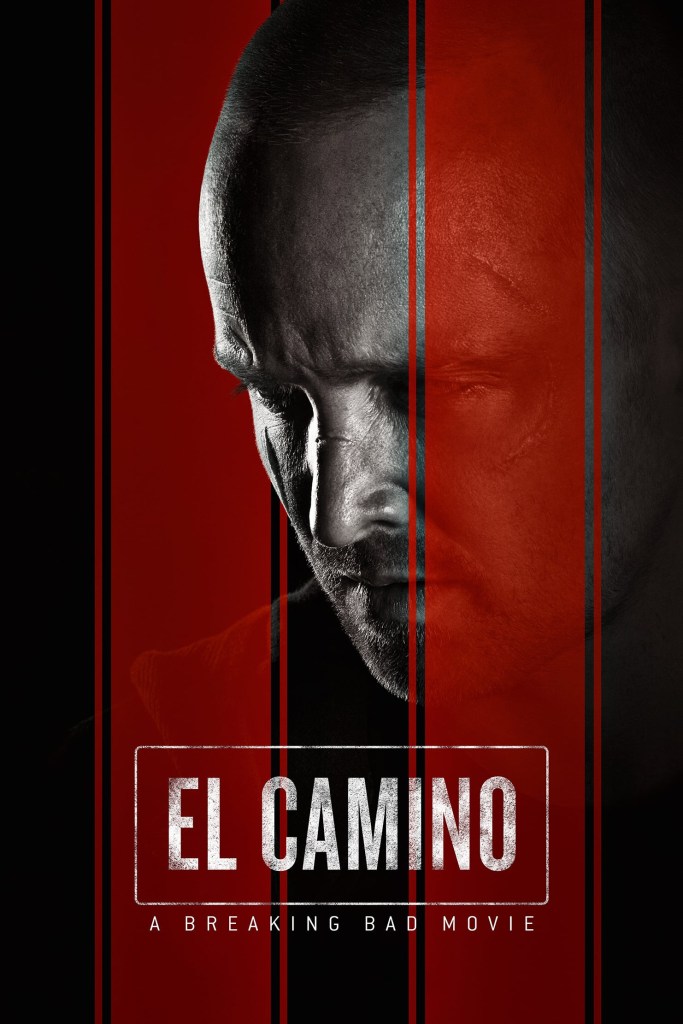
This film acts as a follow-up to the Breaking Bad TV series, following the story of Jesse Pinkman after he escapes the Brotherhood compound and how he then moves on with his life after the severe PTSD he has gained from the events in Breaking Bad. Personally, I cannot see the point of this film. At first glance, I believe there is the potential for this to be a good film, but the direction that Gilligan proceeds to go with this swiftly removes any chance of greatness.
The film begins straight after Breaking Bad; despite being made a couple of years after the series ended, the use of a direct continuation allows the cultural impact of Breaking Bad to continue into the film. The further instalment of the anti-hero narrative allows audiences to further explore the moral ambiguity of fictional characters through Jesse Pinkman. As at the end of Breaking Bad/ the beginning of El Camino, the situation Jesse finds himself in is devastating, and on multiple occasions, I have found myself feeling extremely empathetic towards Jesse, but ultimately, the situation he finds himself in is entirely based on the decisions he has made leading up to this point. Unlike other characters within the Breaking Bad universe, Jesse has been able to develop his own sense of empathy and sorrow. It can easily be argued that his decision to continue working with Walter is only due to the fact that he simply sees no other choices or prospects for himself.
Overall, his unresolved fate gives the film some sense of purpose, offering closure, character study, and epilogue. However, I also believe that to some extent, fans should be able to make decisions about characters’ endings themselves. In a film where so many of the characters rely on moral ambiguity to appear mysterious and powerful, employing ambiguity in the same way when considering the narrative of the film can only be seen as a positive thing, right?
As the film further progresses, the audience is able to follow Jesse’s escape from the Brotherhood compound. This asks the audience to suspend their disbelief in reality, meaning the film asks audiences to avoid using their critical thinking when trying to understand something that would be impossible in reality, to believe it for the sake of enjoying the narrative. Despite the time passed while Jesse was locked away, it is undeniable that he is still a largely wanted man. As he escapes with such ease from the Brotherhood compound, the film asks the audience to suspend their disbelief from now until the end of the film. Additionally, the use of flashbacks within the film further asks the audience to suspend their disbelief; by choosing to make this film through the eyes of Jesse, Gilligan can showcase new key locations within the film through Jesse. The use of a non-linear timeline further assists with the inclusion of new locations. The use of flashbacks while Jesse was being held captive by the Brotherhood introduces the side quests that Todd (played by Jesse Plemons) takes Jesse on. These adventures help the audience realise the extent to which Jesse was trapped by the Brotherhood; alongside this, the casual nature with which Todd treats the situation generates a further sense of empathy and pity for Jesse.
The themes and symbolism that are showcased throughout the film further ask for empathy from the audience when analysing Jesse’s character. Gilligan’s use of juxtaposition within the themes deepens the audience’s ability to feel a sense of pity for Jesse and all he goes through. By putting the themes of freedom and captivity against one another, Gilligan can showcase the large differences that are displaced in the non-linear narrative, highlighting a key difference between the two time periods. Furthermore, the use of identity and reinvention also plays key parts in being able to define Jesse’s character at the beginning of the film and later, who and what he goes on to become. The idea of reinvention can most clearly be argued when considering El Camino.
From the beginning of the film, it is made clear that Jesse’s goal is to escape his past and be able to reinvent himself. The freedom with which Jesse can think about his possibilities for reinvention showcases that, through his newfound freedom, he has been able to change his identity and has been allowed the chance for reinvention, as there are no more physical obstacles in his path.
Jesse’s final decision to go back to the vacuum repair guy and fight for a second chance for escape is the final factor in showing the audience that he has changed for the better. As Walter dies at the end of Breaking Bad, it leaves Jesse somewhat free to do what he wishes with his life, as Walter was the primary perpetrator, without the poison of Walter and other illegal substances poisoning Jesse’s decisions and health. The ending he chooses for himself represents a newfound sense of peace and hope. The audience cannot know for certain that Jesse’s story ends here, but his decision to change his identity and go up to Alaska sparks a sense of hope that he is finally free and able to start a new life away from all that previously hurt him.
My final thoughts on this film circle back to what I thought originally. I still do not fully believe this film was necessary; it can be argued that, at its core, it feels rather like one final money grab from the Breaking Bad universe. Others have been inclined to agree, calling the film entertaining rather than essential. I can admit the film is powerful in showing how much Jesse has changed and grown as a character, but other than that, I cannot see any real need for this film. I am sure there are die-hard Breaking Bad fans out there who completely disagree with me, and I admire them for their self-determination and love for this fandom.

 Ruby Reviews Films
Leave a comment