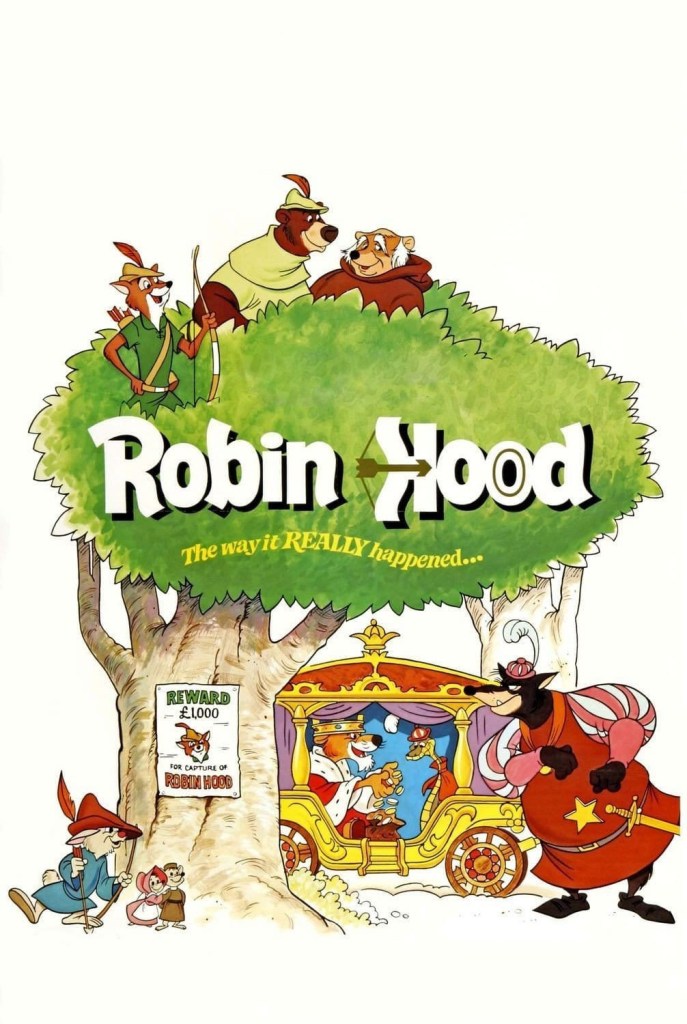
This is a fun take on the classic Robin Hood story. I’ve loved this film since I was very little. It’s always been one of my favourite Disney films, and there’s a high potential that it will always remain a favourite. The film uses the power of anthropomorphism to make the love story of Robin Hood and the Fair Maid Marian relatable and enjoyable for children. This stands out among Disney’s other animated classics; the memorable songs give the film a unique, almost country feeling that’s different from the other Broadway-style musical numbers in many films. This film sits in Disney’s “Bronze Age,” when Disney was figuring out its identity after losing its founder. Overall, the film gives a slightly experimental and less formula-driven feeling when compared to earlier classics and later Disney hits.
The film covers a couple of separate plotlines, although the primary focus is on Robin Hood stealing from the rich to give to the poor. The film opens with the anthropomorphic cockerel giving the audience a look into the backstory of the film and how the characters have ended up in the predicaments they are currently in. This leads to the introduction of the primary antagonist, Prince John and his sidekicks, the Sheriff and Sir Hiss. However, the love story between Robin Hood and Maid Marian is the primary story that the audience is encouraged to follow and support, as it gives a light and charming take on the normally tragic legend.
At the core of the relationship is a childhood connection and enduring loyalty. This implies that the two knew each other when they were younger, adding a sense of nostalgia when they reunite. Marian has been living under Prince John, while Robin is an outlaw in hiding, so their love carries a quiet longing beneath the humour. Unlike more intense and mature adaptations, Marian isn’t just a passive figure; she’s warm, kind, and emotionally perceptive. She understands Robin’s mission and supports him, even though his outlaw life keeps them apart. Meanwhile, Robin’s affection for her reveals a softer side under his clever, mischievous persona. Overall, their 1973 portrays their love as gentle and nostalgic rather than passionate or tragic; the playful and sincere nature of their relationship perfectly matches the film’s tone, making it seem extremely hopeful and rewarding, with a happy ending, matching the classic structure of Disney films.
The film looks light and playful on the surface, but carries several clear themes and messages underneath its humour and music. The central conflict of the film is between fairness and abuse of power. Robin Hood represents justice, taking from the rich, who gained wealth unfairly, and giving to the poor. Prince John, on the other hand, represents corrupt authority, unfairly taxing people for his own personal gain. The message that is ultimately put forward is that authority is only legitimate when it serves the people, not when it exploits them. What is especially interesting about the display of these themes is how they are shown within the film, through the use of anthropomorphism. Disney has been able to flip the connotations applied to each animal, as Robin Hood is a fox with a clear and good moral compass, rather than the usual sly and immoral connotations that are usually applied to the animal. Prince John, on the other hand, is the complete opposite of the brave and loyal animal that is usually presented on screen; he is sly and without a moral compass, constantly happy to take from the poor to make himself richer.
Robin Hood had a surprisingly mixed reception at release, but still went on to become a nostalgic favourite with a lasting cultural footprint. When the film first came out, it left critics feeling lukewarm. The light-hearted tone, catchy songs, and voice performances were praised, but critics were still quick to point out the weaknesses of the film. The animation was seen as recycled and less polished compared to other Disney classics, partly due to budget constraints. Some felt the story lacked emotional depth and narrative originality; comparisons to earlier Disney films like Snow White and the Seven Dwarfs or The Jungle Book made it seem less ambitious. However, over time, the film’s reputation has improved significantly; it has become a cult favourite, particularly among those who grew up with the film in the 1970s-90s. The animated anthropomorphic character designs, such as Robin as a fox, have become iconic and recognisable reinterpretations of the legend. The film began as a modest and somewhat criticised release but evolved into a warmly remembered classic. Its legacy is less about technical innovation and more about charm, humour, and enduring childhood.
This film remains a standout example of how simplicity, charm, and character-driven storytelling can outlast technical limitations or changing trends. Its anthropomorphic cast, catchy soundtrack, and light-hearted take on the classic legend give the film a personality that still feels warm and accessible decades later. The film’s strength lies in its heart, delivering humour, adventure, and timeless themes of fairness and friendship in a way that resonates with audiences of all ages. Whether you’re revisiting it or rediscovering it for the first time, Robin Hood is well worth watching for its enduring charm and feel good spirit.

 Ruby Reviews Films
Leave a comment