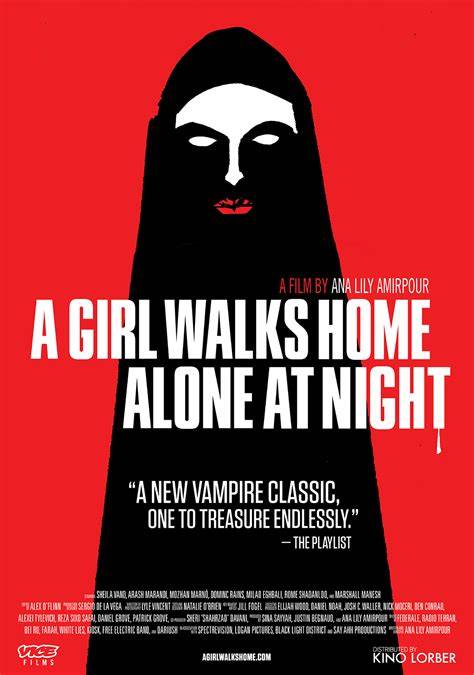
I first came across this film during A-level film. As someone who is not a massive fan of western or vampire movies, I didn’t really expect to enjoy this, but I was truly mistaken! The style of the film highlights clear homages to prior vampire films, such as the 1922 film Nosferatu. However, Amirpour reimagines the somewhat niche genre of ‘spaghetti western’, a term popularised by Sergio Leone, but flips it on its head by including a female lead. The dialogue of the film is entirely Persian and blends elements of Iranian culture with the spaghetti Western-vampire imagery that Amirpour creates.
The reimagining and inspiration Amirpour drew from the spaghetti western genre can be seen in the use of a female lead, played by Sheila Vand, who plays ‘The Girl’. The character fits the archetype as she is a mysterious, lone anti-hero with a vigilante streak. This vigilante streak is realised through The Girl’s actions as the film progresses. This can be argued as all the victims she takes are men who have humiliated or harassed women to some extent, the first victim she takes is a drug dealer named Saeed (played by Dominic Rains). When the audience first sees him onscreen, he has just kicked Atti (played by Mozhan Marno), the prostitute, out of his car, refusing to pay her for her service and slapping her. The Girl follows Saeed home when he invites her in, and she then kills him moments later. The nature in which she kills him is somewhat sexual, as after she is invited into his home (employing a stereotypical vampire troupe), her first act with Saeed is to sensually suck his finger, conforming to Freudian ideas of the yonic as the finger penetrates her mouth.
Upon a first look, it appears as if The Girl submits to what Saeed wants and sexually desires from her. However, seconds later, she bites off the finger, allowing the power between the two to be flipped, and this further presents the idea that the character of The Girl is a vigilante fighting for the greater good for women. Overall, this subverts the idea presented by the film’s title, as a vampire, she can freely roam the city’s streets. As she is the perpetrator and therefore possesses agency and power, somewhat unusual for a young woman, especially when considering the crime-ridden urban setting, such as Bad City. When considering all of this, it is easy to see how the film has feminist leanings.
Overall, this film received positive reviews from critics, holding an 96% approval rating alongside an average rating of 8/10 on the website Rotten Tomatoes. Ultimately, critics agree that the film stands out as something beautifully original, acting as a unique calling card for Amirpour and all she stands for. Various other film critics have further complimented the film and its feminist themes. Drew Taylor of IndieWire graded the film as Grade A, and went as far as to say that it gives “the impression that you’re witnessing something iconic and important unfold in front of you.” The largely positive reviews further the overall impression of the film, sparking positive connotations when considering all aspects. I can only further the positive rapport Amirpour has received, as, personally, I cannot find any specific fault with this film. I believe it is a masterful and timeless piece of cinema that will continue to make an impression on future generations as long as it is continued to be displayed.
Despite the film’s fictional setting of “Bad City”, there is a clear connection to Iranian culture that is clear throughout the film. There is a clear uncanny quality within the location, making it seem both familiar and placeless. It operates less as a real location and more as a symbolic landscape of cultural displacement and moral decay. Amirpour further plays into this idea of cultural displacement, as there is no explicit geographic grounding within the film despite the use of strong Iranian elements. The film was shot in California, but is populated entirely with Persian language and imagery, creating an “everywhere but nowhere” effect and suggests the film reflects a diasporic identity caught between cultures. This can further be shown in the genre of the film, as it mixes Western with Vampire, being the first to do so, it creates a strange hybrid genre that perhaps isn’t entirely sure what it truly is. As characters constantly switch between cultural signifiers such as language, clothing, and music, it further reinforces this idea of cultural hybridity. For example, The Girl’s chador acts as both a traditional garment and a superhero-like costume. The use of The Girl’s costume further creates some sense of moral ambiguity and social decay through the large presence of crime, addiction, and exploitation within the city; the few “normal” social interactions within the film are still primarily transactional or predatory. The city itself can enable and normalise the moral ambiguity of characters, and The Girl emerges as both a product and regulator of this environment, by contributing to the violence and chaos of the streets, but also through her decisions to kill the men who abuse the transactional and predatory relationships they have with the streets of Bad City.
Ultimately, this is a film that resists a tidy ending, choosing instead to focus on the uncertainty that presents itself. Amirpour leaves the audience in a world where morality is blurred and where justice comes quietly and often with violence close behind. The relationships that The Girl can form are often suspended between the senses of hope and danger. The lack of clear conclusions to the film means that the audience will never know if she truly got a typical happy ending. However, this film is still immensely easy to endure and is incredibly enjoyable. By inviting a sense of reflection rather than closure, it transforms itself from a genre experiment into something that feels more long-lasting. I would wholeheartedly recommend this film to someone who has not seen it before, it is inspirational and strangely heartwarming as audiences are encouraged to root for and support the character of The Girl.

 Ruby Reviews Films
Leave a comment