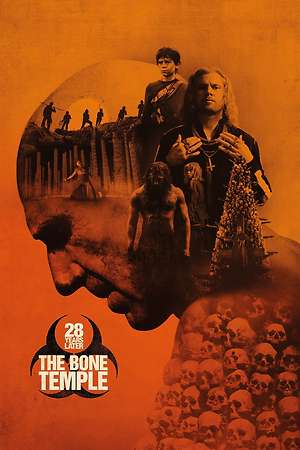
This film offers a promising glimpse into the cinema of 2026. I went into the screening of this with quite low expectations, knowing I hadn’t seen the first two films in the franchise, and I hold no particular love towards zombie films. I was heavily encouraged to watch this by my Dad, who is a much bigger and more committed fan than I am, even going to the double-billing of the two 28 Years Later films at the beginning of January. Admittedly, I’m far more likely to watch the first two films in the franchise now than I was before. The Bone Temple was incredible, brilliant, and completely utterly peak. From start to finish, I was immensely engaged in the new characters introduced in this film; the Jimmies in particular were incredibly interesting.
The Jimmy characters play a huge role in this film. After being introduced at the end of 28 Years Later, it can be understood that the group is a post-apocalyptic, cult-like organisation that erases individuality through the use of names and costumes. The practice of giving everyone a ‘Jimmy’ name symbolises how the group erases individuality in favour of devotion to Sir Lord Jimmy Crystal’s ideology. The horrifying acts the Jimmys commit are commanded by Sir Lord Jimmy Crystal, who is portrayed by Jack O’Connell. he’s a long-term survivor of the Rage Virus apocalypse; he lost his family in the initial outbreak and grew up being shaped by that trauma. One of the consequences of his trauma is the strong belief he holds in his own mythos and power. The use of his exaggerated titles, such as “Sir Lord”, is an example of this. Although the characters’ idolisation of Jimmy Saville (seen through the naming of the cult) can be seen as problematic, as the virus began in 2002, Jimmy would’ve been a child and therefore would not have known about Saville’s disgusting behaviour. This works as a great critique of the amnesiac nostalgia behind British nationalism and MAGA. Jimmy, clinging to the comfort of the memories of the TV he watched as a child, heavily plays into the religious and satanic imagery he later employs to control his followers.
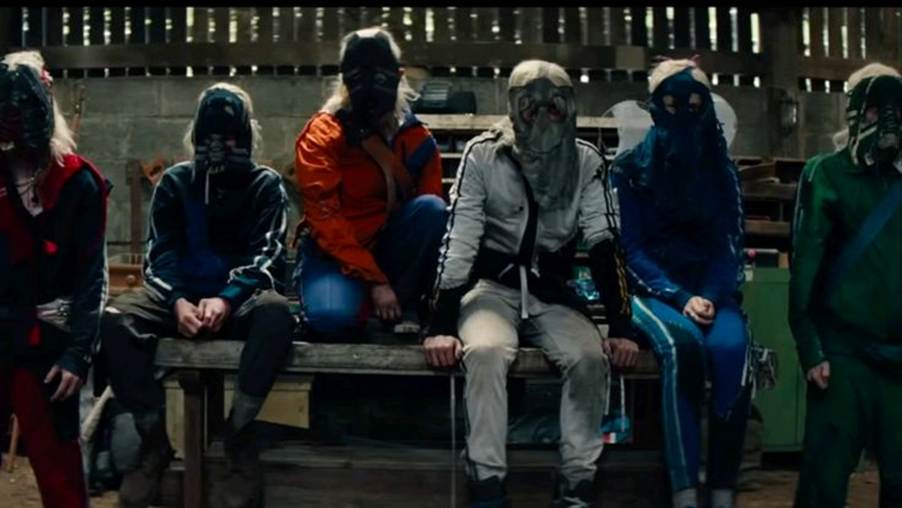
The composition of the Jimmys in the image above argues for an almost ritualistic staging, suggesting that collective identity holds a higher importance over individuality. No character is centred as a hero; instead, the whole group becomes the subject of the image. As the camera sits at eye level, it creates a sense of unsettling neutrality. The audience is forced to confront the characters as equals. This kind of blocking recalls cult imagery and tribunal scenes, where presence matters more than personality. Each Jimmy wears some kind of face covering, which still allows them some kind of individuality, but they are reduced to an aesthetic, as there is a disregard for inner meaning. The masks erase facial expressions, stripping the characters of empathy and emotional legibility. Additionally, the tracksuits and sportswear add a distinctly British feel to the scene, which adds a recognisable, working-class element to the film.
Ralph Fiennes’ performance within this film is another element which deserves further analysis, although his role is technically smaller than in the first 28 Years Later, there is no doubt around the fact that he is equally, if not more, engaging and unique as a character. Kelson’s interactions with the Alpha-infected, Samson, tide over from the prior film, with the two seemingly engaging in some strange kind of friendship. Towards the beginning of the film, this friendship only seems possible through the use of the small drug-infused darts Kelson continuously shoots Samson with whenever he comes to Kelson’s camp. However, as the film progresses, Kelson grows more and more attached to Samson, glad to have someone to talk to despite how unresponsive he seems. At a dramatic moment of climax Kelson is about to euthanize Samson when suddenly he utters a singular word, “moon” although this revelation is seemingly small, it is a huge deal for Kelson, it offers something new. A cure for the infection. With this in mind Kelson goes about finding a cure for the rage virus. Some attempt for compassion in this horror-stricken world. This attempt to help Samson regain his humanity can arguably be seen as a mirror to how in the first 28 Years Later Kelson, Spike, and his mother care for the human baby delivered from the dying infected woman on the train. Despite the repeated inhumane natures shown by the infected there are still small moments which argue for a deeper hidden humanity within their minds.
With Kelson’s determination to find a cure for Samson’s infection on the forefront of his mind it can serve as little surprise to the audience that he is eventually found and approached by Sir Lord Jimmy Crystal and the rest of the Jimmys. As it is believed he is the great ‘St. Nick’ who is believed to be Jimmy Crystal’s father, when Jimmy Crystal learns of this he immediately goes and asks Kelson himself. Upon realizing he isn’t St. Nick, Kelson is either given the choice to play along with Crystal’s plan to trick the Jimmys or he will be killed by them. Upon learning this, Kelson agrees to play along with what Crystal wants from him. Knowing his time is now limited, Kelson serves Samson a variation of different pills in attempt to free him of the infection, this interaction is one of the last ones between Samson and Kelson before the arrival of the Jimmys. The show Kelson puts on for Crystal and the Jimmys is truly the primary spectacle of the film, this scene is so visually and audibly incredible, the use of ‘Number of The Beast’ by Metallica makes for a gorgeous and memorable scene which is perfect for the film. When the song was first released in 1982 it caused huge controversy in the United States where the subject of the song caused outrage among many religious groups. Despite of this, the song remains one of the band’s most popular songs, reaching No. 18 in the UK singles charts upon release, and No. 3 on twice in 1990 and 2005. Kelson’s decision to perform this song for the Jimmys makes perfect sense as when it was first released religious groups performed mass burnings of the album, this is repeated within the film as Kelson sets a huge fire alongside satanic propaganda for his performance, the use of the upside down cross is key example of this as within popular culture the symbol is used to display demonic themes. Overall, Fiennes’ performance as Kelson serves as a key part of the film, the characters kindness and humility adding a fresh and freeing feeling to this dystopian zombie film.

 Ruby Reviews Films
Leave a comment