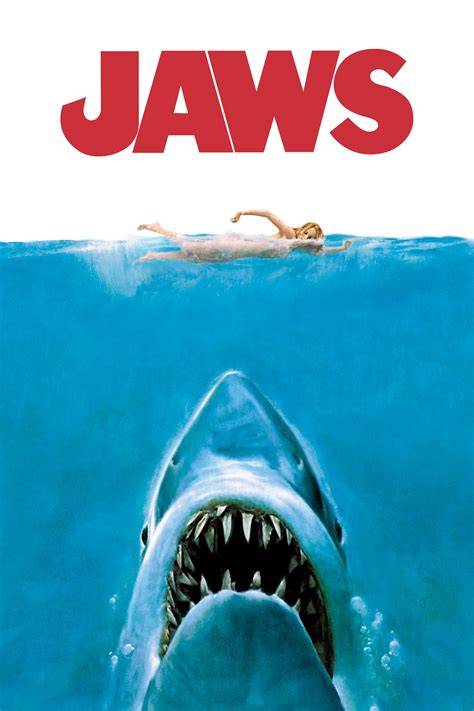
From the beginning I wasn’t keen on watching this film at all. I am not a fan of sharks, blood, or high tension in movies and this film contained all three. And despite my aversions at the beginning, I did manage to gradually relax and enjoy this film more and more as it proceeded. Admittedly, I find it difficult now to remember the names of any of the character, aside from the shark, but ultimately it is the film’s iconic score that helps make this film so memorable over so many years. The lengthy ‘duuuun dun duuun’ as the film grows to become more tense, subtly alerting the spectator to the presence of the shark as it becomes a bigger and scarier threat to the main characters. Despite Spielberg’s extensive filmography and wide reach within the film industry, this is only the third film of his that I have watched.
The film begins on a seemingly peaceful night until suddenly two young people separate themselves from their large group (the first mistake in a horror film) and then suddenly the girl strips her clothes off and goes into the sea topless. Ultimately, this ends badly, and she ends up dead. When she is discovered by her partner and reported to the police the real mystery and deceit begins.
As this brings us to the introduction of our protagonist Chief Brody (played by Roy Scheider) who immediately marks the tragic incident as the consequence of a shark attack. However, as the beach town this movie is set in (Amity Town) relies completely on the large influx of tourists during the summer months, the mayor is reluctant to shut the beaches as it will reflect badly on businesses and limit the quality of life for the people living in Amity.
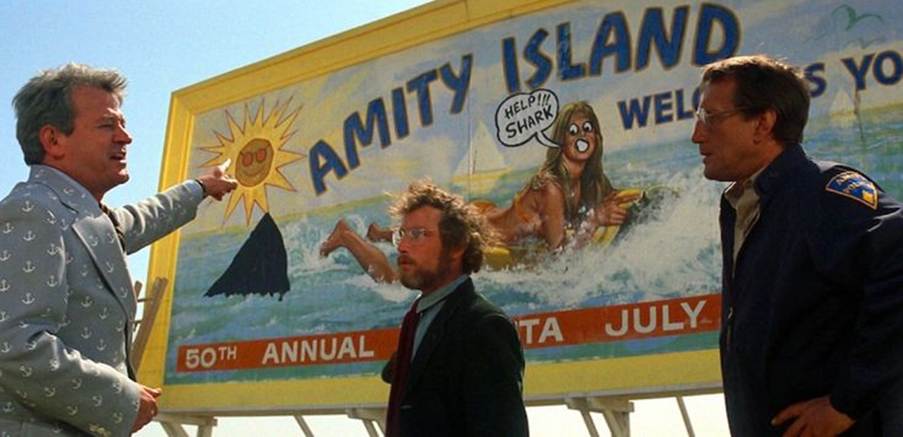
The rule of thirds within the picture above helps convey the conflicting priorities and desires of the Mayor and Brody. As the Mayor is placed in the forefront of the shot he appears as the more visually attractive person within frame, this is amplified by his light blue suit as the spectators eyes are more easily drawn to this. Alternatively, Brody appears more mysterious and contemplating as he wears his police uniform, proving his authority and power. Although ultimately this proves worthless as under persuasion of the Mayor, Brody is convinced to mark the girls death as a boating accident. In the long run the effect this has on the small town is devastating as it ends in many more avoidable tragic deaths. This highlights the power imbalance within the town aligning with Kivel’s idea of the man box, as the Mayor polices how Brody reacts to the death of the girl and then is able to manipulate his reaction to gain the response he wants, which benefits both his reputation and the financial stability of the people in Amity.
Despite Spielberg’s extensive history within the film industry (directing 44 films throughout his career), I believe it is not possible to label him as an auteur (Andrew Bazin) as his filmography contains such a wide range of movies, from Schindler’s List (1993) to Indiana Jones and the Last Crusade (1989). The large variety in genre and style within his films makes it difficult to highlight Spielberg as an auteur as there remains a lack of clear theme throughout his films. Despite this, the consistency of deep, moving, and emotionally moving scores within the majority of his films can offer a counter argument to the idea that Spielberg can be seen as an auteur.
A clear example of his iconic scores is obviously from Jaws, as whenever the Shark approaches a skin-crawling and heart racing sound begins to play. This motif occurs enough throughout the film for spectators to instantly pair it with the shark as the sound is non-diegetic it gives the audience a clear alert that danger (the shark) is approaching and immediately puts them on edge.
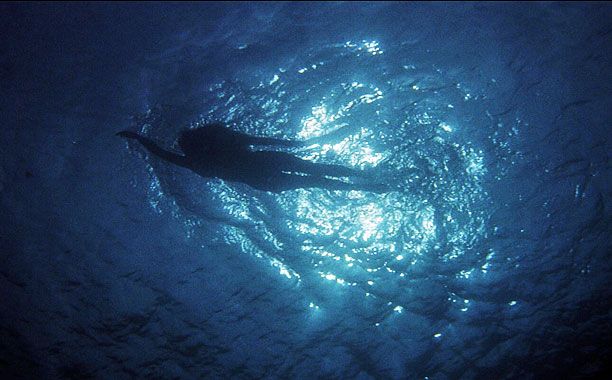
This opening scene further creates suspense and helps create tension within the audience from the beginning of the film, as the theme tune plays as the shark approaches for the very first time this aligns with Knowles Marshall’s film theory around the types of film sound, as she highlights the importance of film sound within movies. As the Jaws song is such a important and memorable part of the film it proves the importance music within films hold and how it can often be overlooked. As the theme song is non-diegetic it is purely to evoke reaction for the audience. This is a common tactic within Spielberg’s movies as within E.T. the Extra-Terrestrial (1982) The sequence where Elliot and E.T. fly in front of the moon is accompanied by a crescendo of brass instruments that evoke a sense of freedom and joy that is essential to the film.
Ultimately, Jaws is a brilliant film and the beginning of amazing Blockbuster cinema that is still carried on today. I’m still not a huge fan of films of this adventure/ horror genre, but the films were especially engaging and enjoyable. I found Quint’s character especially enjoyable and felt his death was undeserved but cinematically an amazing moment. Overall, this is one of Spielberg’s best and will be remembered forever.

 Ruby Reviews Films
Leave a comment