
First, I want to say that this film is brilliant, it’s one of my all-time favourites. This beloved teen romantic comedy that artfully adapts William Shakespeare’s The Taming of the Shrew into a late-‘90s American high school setting. The other day, I put it on for my family, and my younger brother enjoyed it. I think everything about this film just works so perfectly together. Gil Junger’s direction helps make this film a true masterpiece. The casting, music, and storyline are all perfect and work amazingly together and successfully create such a hilarious and entertaining film. Heath Ledger and Julia Stiles’ acting is brilliant in this, they work so well together in creating a storyline that is both believable and magical. The film is truly timeless and will continue to be enjoyed by people for years to come.
The film explores the themes of feminism and individuality in bold and clever ways, especially through its protagonist, Kat Stratford. Kat is a feminist character who rejects traditional gender roles, as shown through her resistance to conform to what’s expected of her as a teenage girl. This is shown at the beginning of the film when Bianca and Kat argue at the beginning of the film and Kat reveals she has no interest in being liked, looking cute, or dating. The contrast between the two sisters calls upon Strauss’ idea of binary oppositions as the two sisters are so different in their appearances and within their ideologies, as their outlooks on life also differ extremely. Furthermore, Kat consistently defies male authority, she speaks up against guys who act entitled or controlling, such as Joey or even her dad’s overly strict rules. This ties in with Kat’s defiance of the patriarchy; she reads Sylvia Plath, calls out misogyny, and questions the sexist norms at her school (such as the English class scenes).
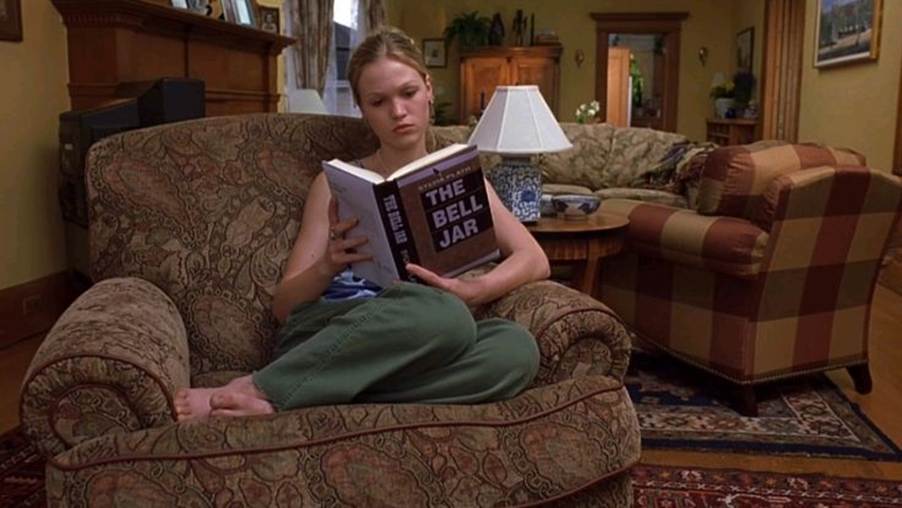
The use of framing places Kat (played by Julia Stiles) in the centre of the frame, emphasising the fact that she is alone. Her solitary position underscores her isolation and sense of individuality within the domestic space, reminding the audience of her rejection of stereotypical expectations for women as she rejects the performative femininity her peers often embrace. Junger can further convey this through the fact that Kat is reading Sylvia Plath’s The Bell Jar, a key feminist text exploring mental health, societal pressure, and the struggles of being a woman in a patriarchal world. This reinforces Kat’s intellectualism, inner conflict, and desire to push against societal norms. It also foreshadows her vulnerability, adding depth to a character who often presents as tough and guarded. Overall, this helps the film critique how society rewards girls like Bianca (who conform) and punishes girls like Kat (who resist), showing the double standards teenage girls often face.
The iconic scene where Patrick serenades Kat is another moment within the film that deserves to be looked at, as it parodies the classic rom-com trope of the “grand romantic gesture,” but makes it punk and playful, which is very on-brand for Patrick. As he performs from the bleachers, using a mic and loudspeakers, turning a private feeling into a public performance, mirroring his risk-taking and growing sincerity for Kat. The scene artfully balances comedy (him running from the campus police mid-song) with earnestness, making it endearing rather than cringe. The unexpected inclusion of the band adds whimsy and reinforces the idea that even outsiders (like Patrick and Kat) can be the centre of attention, in a good way.

This scene highlights Patrick’s turning point; he stops being just “the mysterious bad boy” and shows a sense of vulnerability that challenges toxic masculinity through the expressive performance of the song. Additionally, despite the over-the-top nature of the performance, the audience can see that Patrick is beginning to genuinely care for Kat. The low angle of Patrick in the image above, alongside his direct gaze into the camera, suggests an air of confidence, but not arrogance; he’s risking embarrassment in front of everyone to connect with Kat. Within the sequence, Heath Ledger can put on a performance that is confident and convincing but not mocking. His smirk and twinkle-in-the-eye energy (Argyle’s body codes) highlight the fact he’s playing up the drama, but ultimately his performance is grounded in sincerity. Typically, in rom-coms, it’s the girl who chases emotional openness. Here, the roles are reversed: Patrick becomes the expressive one, making himself emotionally available. Kat’s reaction isn’t performative either, it appears real. She doesn’t have to perform in a manner that is feminine or vulnerable. She just feels it, it is authentic.
Another important relationship within this is the subplot between Cameron and Bianca, although it appears to be lighter and more straightforward than Kat and Patrick’s relationship, it’s a smart commentary on youthful infatuation, self-discovery, and the performance of romance. Thematically, their relationship holds significance as it begins with Cameron and Bianca idealising each other, him thinking she’s perfect, and her seeing him as “just a tutor.” But as the film progresses, they both confront reality: Bianca isn’t just a “dream girl,” and Cameron isn’t just a passive admirer. As their relationship matures, so do the characters; it’s not just about fantasy anymore, it’s about respect and real connection. Much of their tension comes from a lack of honest communication, which mirrors Kat and Patrick’s arc, but is far less intense. Once Bianca realises how Joey was using her, Cameron becomes a symbol of genuine interest and emotional presence.

This moment from the film captures a pivotal moment in their subplot, one that’s full of sweetness, sincerity, and emerging mutual respect. As the sequence takes place in a library, a place of learning, it reflects the idea that their connection is growing through intellect and conversation, not performance or popularity. This highlights the sincerity of their connection and reinforces the idea that it is genuine. The background is softly lit and blurred, ensuring the audience’s focus stays on the characters. It also makes the space feel private within a public environment. This aligns with David Bordwell’s ideas surrounding film poetics as the scene above can create meaning for viewers, but also aesthetic pleasure through the choices around costuming. As Bianca wears a red cardigan, perhaps hinting at her growing feeling for Cameron, alongside highlighting her growing confidence and agency. This contrasts with Cameron’s dark sweater; it is neutral and sincere. He’s present, earnest, and vulnerable. He isn’t trying to impress with clothes, he’s just being himself. This sequence highlights their genuine emotional growth with the more performative aspects of teenage romance, reminding us that intimacy can be tender and awkward.
Ultimately, 10 Things I Hate About You isn’t just about who ends up with whom. It’s about how we chose to love, and how that love must begin with self-awareness, authenticity and the courage to defy expectations. This is what allows it to become more than just a Shakespeare adaptation, it’s a quiet revolutionary take on coming-of-age. That is what makes this film so accessible to so many generations, it is moving and heartfelt meaning everyone can relate to it somehow.

 Ruby Reviews Films
Leave a comment