
With a fourth Bridget Jones film recently announced I find now being the best time to finally watch this iconic romcom trilogy, starring Renée Zellweger, Colin Firth, and Hugh Grant. Despite the amazing medley of films, I’ve decided to only talk about the first one and it’s currently the only one I’ve watched. It was my mum who first suggested I watch this though, and albeit slightly reluctantly, I sat down with her, and we began to watch it. I’ll admit I was slightly bored at first but as the film progressed my interest grew. Despite this film being a few years old now I still found it really funny. The fight scene between Mark Darcy (played by Colin Firth) and Daniel Cleaver (played by Hugh Grant) will always be a massive crack up and an all-round legendary sequence. The film also places the perfect Bridget-esque spin on the regular melodramatic normality of Bridget’s life vs. the wild adventure the spectator watches her advance on throughout the film, helping make the film so memorable and unique. After watching this film, I found out it was loosely based on Jane Austen’s Pride and Prejudice, with Colin Firth playing a modern version of Mr. Darcy (a role he also plays in 1995 Pride and Prejudice miniseries).
What really interested me about this film was the complex feminist perspective that can be applied as it both challenges and embraces traditional gender roles. As the film portrays Bridget navigating love, her career, and her own self-worth, it also reflects some of the societal pressures places upon women, particularly in the late 1990s and early 2000s. The film breaks the “Perfect Woman” ideal, unlike many romcom heroines of the time, Bridget is perfectly Imperfect, she is messy, untidy, and relatable. She smokes, drinks, and makes mistakes. The film is able to normalize the life of an “ordinary” woman pushing back on the unrealistic beauty and behaviour expectations often imposed on women.
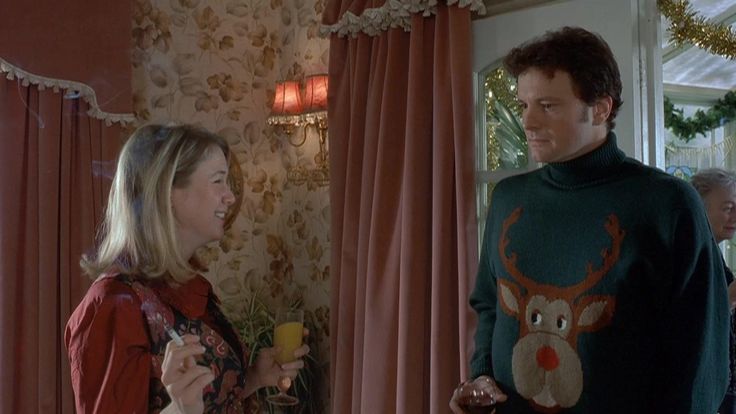
The image above highlights the changing societal and behavioural norms of our society, with smoking no longer being permitted in inside spaces. This image also depicts the first meeting of Bridget Jones (played by Renée Zellweger) and Mark Darcy (played by Colin Firth). Furthermore, this offers a critique of the societal expectations of the time, Mark is expected to be the perfect, wealthy, serious professional, and Bridget is expected to be slim, married, and socially polished woman. The image visually reinforces their discomfort in these roles as the use of framing within the sequence places Bridget and Mark as slightly off-centre, emphasizing the distance between them. Additionally, the doorway behind Mark suggests an exit or transition, symbolizing the potential for change in their relationship, even though they are not yet emotionally close.
The contrast between Colin Firth’s Mark Darcy and Hugh Grant’s Daniel Cleaver is one of the film’s key dynamics, representing two archetypal love interests: the “good guy” vs. “bad boy.” Their characters serve as romantic foils, but also as a deeper commentary on modern relationships and societal expectations for men.
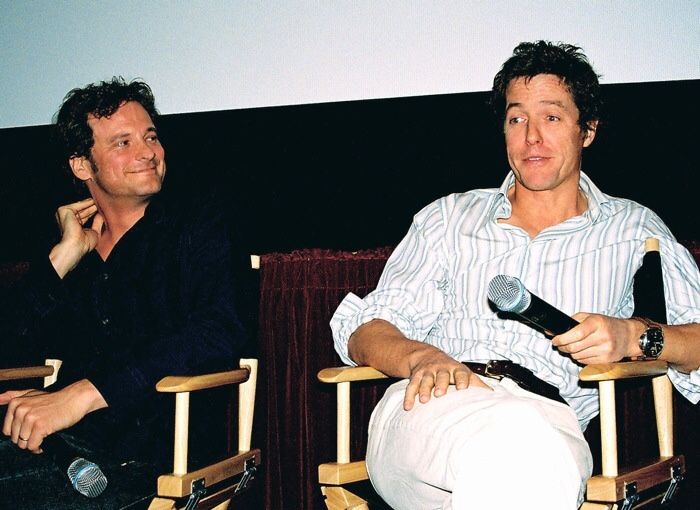
Comparing the performances of the two men highlights the differences in their characters, Firth’s performance is subtle and emotionally complex, allowing him to show Mark’s emotions through series of micro-expressions rather than grand gestures. He allows awkward silences to speak volumes, making his eventual emotional break throughs even more powerful. Throughout the film his emotional connection with Zellweger only grows, highlighting how their chemistry is built on understated moments rather than obvious romantic cliches. Hugh Grant on the other hand offers a performance that is magnetic and playful, he leans into a natural comedic timing, allowing him to deliver his lines with an effortless wit and charm. Grant is able to make Daniel Cleaver undeniably attractive, despite his clear flaws, making it easy to understand why Bridget falls for him. His unique ability to be seductive and insufferable adds layers to his character, he isn’t a pure villain, but rather a flawed and self-serving man.
One of the most beloved moments in this film is the brilliantly unpolished fight between Mark Darcy and Daniel Cleaver. Unlike typical Hollywood brawls, this scene is realistic, awkward, and completely British take on the male showdown. This scene is so iconic as it subverts the typical Hollywood fight scene trope, most romcoms feature intense, choreographed fights where men effortlessly throw punches. Here, however, two upper-middle-class British men clumsily flail at one another, hesitatingly throwing punches at one-another in a way that almost appears polite. The lack of fancy camera angles and slow-motion action allows the sequence to easily descend into pure chaos, only adding to the hilarity of the film. Overall, the fight is more funny than aggressive, reflecting the light-hearted tone of the film, additionally, the use of the up-beat song “It’s Raining Men” adds an ironic, and almost theatrical element to the film.
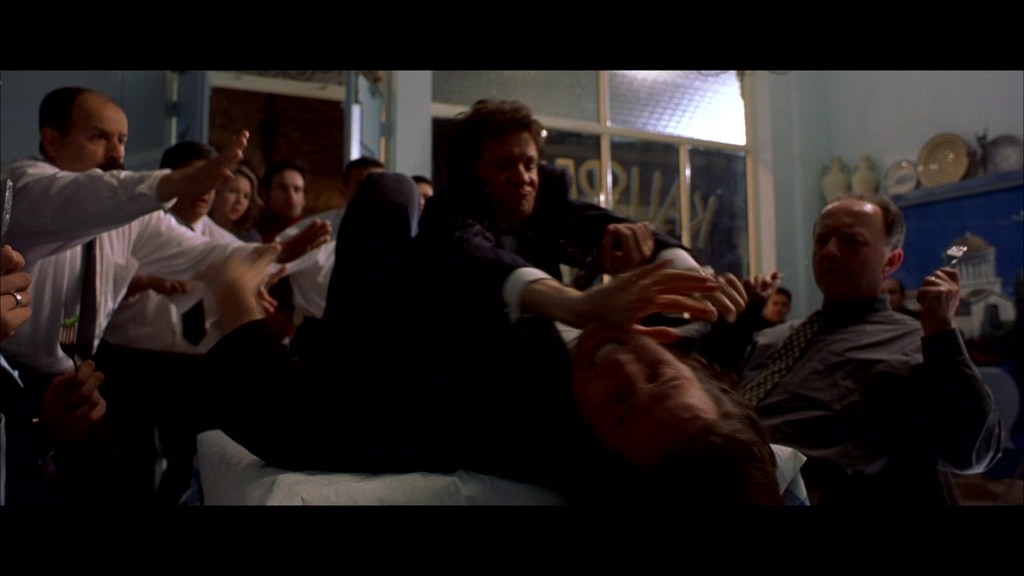
Watch the fight scene here: Bridget Jones’s Diary fight
Mark and Daniel awkwardly grapple at each other, displaying their lack of fighting experience, This deflates the normal hyper-masculine, action-hero bravado that is normally seen in other romantic rival showdowns, this removes the sequence from the constraints of Kivel’s man box as the sequence challenges the hegemonic masculine values of the time through the lack of hyper-masculinity. As the fight spills into a restaurant, a public and inappropriate place for fighting, it reinforces the social awkwardness of the moment and contrasts the personal intensity of the rivalry between the characters and the mundane reality of everyday life (personally, I would be incredibly interested if a fight broke out in one of my local restaurants). Ultimately, this scene helps reinvent the romantic rivalry trope by making it hilarious, relatable, and deeply character driven. Instead of a glorified action sequence, it offers a socially awkward, slapstick fight that perfectly aligns with the themes of the film surrounding imperfect love and real-life romances.

 Ruby Reviews Films
Leave a comment