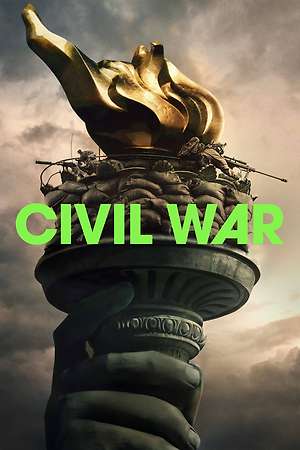
Originally, I wasn’t keen on seeing this at the cinema but thanks to my Cineworld Unlimited card I gave it a try. Overall, I liked the premise of this film as the film is dystopian which is one of my favourite genres in film. I’m also a huge fan of A24’s films so that made me slightly more interested in seeing it at the cinema. Alongside this, the narrative of the film is brilliant and so relevant to today’s society and politics. It’s set in a near-future United States caught in a civil conflict between a totalitarian federal government and secessionist movements. The film follows a team of war journalists travelling from New York City to Washington D.C. aiming to interview the President before rebels seize the capital. The cast is varied and extremely talented, including Kirsten Dunst as the seasoned war photographer Lee, Wagner Moura as Joel, and Caliee Spaeny as the aspiring photographer Jessie. The film is praised for its intense realism and Kirsten Dunst’s emotive performance. The themes explored throughout the film can be applied to society today as the ideas of political polarization and civil unrest can be seen in today’s American society, moments such as the U.S. Capitol Riot highlight the idea of distrust through the misinformation of American society.
This film touches on many powerful themes that explore the complexities of the influence of the media, and the human condition in times of conflict. The role of media in times of crisis is a key theme within this film. The main focus is on a group of war journalists trying to document the conflict and document the truth, they are caught in a battle over competing narratives.
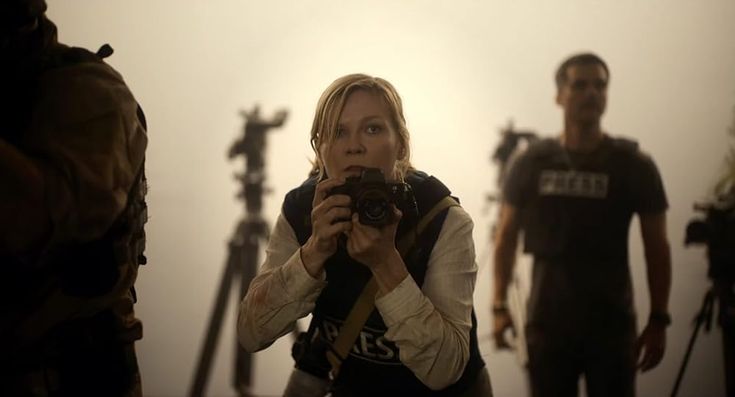
As Kirsten Dunst is in the centre frame, and the only person in focus the spectator is immediately drawn towards her. The image promotes a sense of contrast as Dunst holds her camera, while to her left, a solider can be seen rushing out of frame, the juxtaposition between the two connotes a sense of worry for Dunst as it becomes clear she is entering a volatile area. Additionally, the muted colour palette adds a dystopian feeling to the film, as the dull colour palette can be recognised as a key characteristic of the dystopian genre of film. It can be argued Dunst’s character challenges American hegemonic values throughout the film, but it can be seen here. As she is the only woman in the frame it gives the impression that there are few female war photographers, and as her job is so difficult it can be assumed it is a male-dominated role. This implies the importance of the media in a time of crisis, as it’s clear Lee (played by Kirsten Dunst) is risking her life by venturing into the dangerous area, alongside this, Lee can shine a light on events powerful organisations may want to conceal, offering a powerful mode for social change and ensuring that atrocities aren’t forgotten.
Another powerful theme within this film is the split ideological extremism of the country. The film explores the consequences of extremism through the lens of a country torn apart by civil conflict. Rebel factions and the government are each driven to their own ideological goals, with little to no room for a middle ground. This theme resonates within the film but also in real-world scenarios where extremist ideologies can escalate into violence, political conflict, and even civil war.
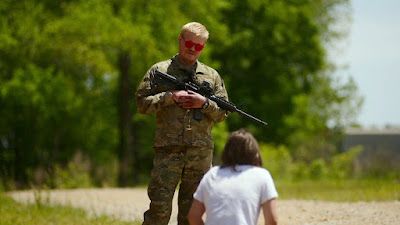
The image above highlights the radicalisation of Americans within the film, as the power dynamics of Jessie (played by Cailee Spaeny) and rebel places Jessie in an extremely unprotected position, highlighting the use of violence as a means to achieve goals, this is exceptionally dangerous as the idea of justified violence allows for the removal of moral boundaries in pursuit of a cause. Additionally, the mise-en-scene of the man standing above Jessie can have multiple effects, as he has a gun promotes a sense of fear, which is reflected in Cailee Spaeny’s performance. Additionally, the image promotes a sense of ridiculousness as he wears bright red sunglasses, removing part of the domineering persona the character puts forward.
When comparing real-life political events to the scenario presented in Civil War, the themes of ideological extremism, political polarization, and civil unrest are very relevant. Although Civil War depicts a nation forced into conflict over deep political divides, real-world political events often provide similar tensions, leading to crisis, protests or even civil war. The American Civil War (1861-1865) is an example of this, fought between the Union and the Confederacy. Fundamentally, this was a conflict over slavery and states’ rights. This was a product of fast-escalating political polarization, ideological extremism, and an extremely divided society. As the tension continued to rise, compromise became impossible, and both sides engaged in a violent and bitter struggle for survival and control over the direction of the country. Much like in the film, the U.S. Civil War centred around extreme ideological differences, states’ rights and slavery vs. abolition and union. In both cases, extreme beliefs became the driving force behind violent conflict, where both sides refused to compromise, eventually leading to an all-out war. In the film and in real life, ideological extremism and polarization lead to destructive conflicts. In any scenario, compromise becomes difficult, and violence becomes a tool for forcing political change. The abundance of real-world examples highlights how toxic dynamics such as extreme political, religious, or nationalist ideologies threaten to tear societies apart.

 Ruby Reviews Films
Leave a comment