
This is my favourite film/ book of the Hunger Games franchise; I love all the films, but this one takes pride of place in my heart. The way Francis Lawrence has transformed Suzanne Collin’s original book into a film that is true to the manuscript while still providing originality and flair. The film is set after Peeta and Katniss’ unexpected victory in the 74th Hunger Games, as the two embark on a victory tour across Panem. As their defiance of the Capitol has sparked unrest in the districts. President Snow sees Katniss as a symbol of rebellion and seeks to eliminate her. In attempt to keep his control Snow announces the 75th Hunger Games (a Quarter Quell) in which he brings back past victors to fight once more. As Peeta and Katniss form alliances with past tributes, including Finnick Odair and Johanna Mason. The Games take place in a deadly environment, but Katniss and her allies uncover and plot a secret plan to overthrow the Capitol and escape the arena. The film ends with Katniss destroying the arena’s force field, leading to her rescue by the rebels, while Peeta is captured by the Capitol. The film explores themes of rebellion, oppression, survival, and sacrifice. The film received critical acclaim for its darker tone, strong performances, and thrilling action sequences.
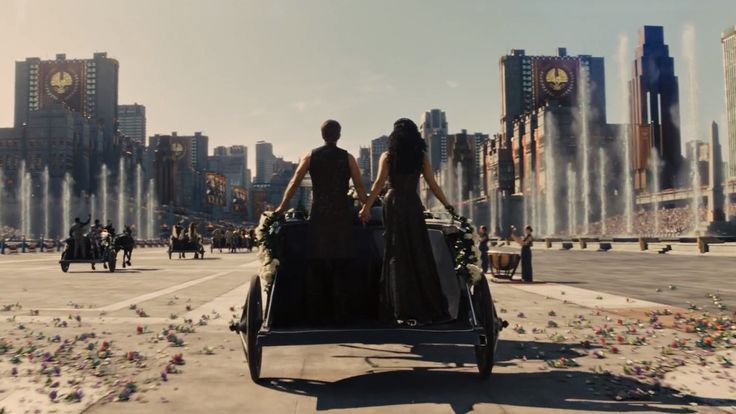
There are many crucial scenes within the film, playing crucial roles in shaping the rebellion and Katniss’ transformation into the Mockingjay. The sequence with Katniss and Peeta on entering the tribute parade on the carriage is one of the film’s most visually striking and thematically importance moments. This scene acts as a turning point in the film, it visually reinforces Katniss’ transformation from a survivor to a revolutionary. The combination of cinematography, costume design, and symbolism helps make it one of the most memorable moments in Catching Fire.

The muted tones create a binary opposition (Strauss) to the grand buildings and the setting, this shows the difference between the artificial beauty of the Capitol and the grim reality of the Games. As the use of a wide shot places Peeta and Katniss in the centre of the screen, leading towards the grand architecture of the Capitol, suggesting that their fate will always lead towards Panem and the corrupt power of the Capitol. Additionally, the use of deep depth of field ensures both the characters and the vast environment are clearly visible. The proxemics of the two characters creates a sense of rebellion alongside mirroring their previous actions from the first Hunger Games. The closeness of the characters creates a sense of solidarity and their body codes (Argyle) gives the impression that the characters are stronger together.
One of the most emotional sequences within the film happens when Peeta gives Katniss the locket, it highlights Peeta’s deep love for Katniss, as well as the growing complexity of their relationship.
As Peeta and Katniss are in silhouette, helping emphasize the emotional depth and vulnerability of the scene. The juxtaposition between their dark forms and the glowing water creates an intimate, almost dreamlike atmosphere. The medium shot captures both characters from behind, focusing on their body language rather than their facial expressions. Additionally, the reflection of the water adds a sense of warmth to the scene, suggesting Peeta and Katniss are able to find moments of calm together amidst the brutality of the Games. The beach and water symbolize tranquillity, and the beach represents a place of transition, hinting at the beginning of Katniss’ genuine romantic feelings for Peeta. This is further amplified through Peeta’s self-sacrifice as it reinforces his role as the selfless protector. Furthermore, his willingness to let Katniss live instead of him foreshadows his sacrifices in later films.
The film explores deeper political, emotional, and psychological themes compared to its predecessor. As Katniss unintentionally becomes the symbol of rebellion and inspires the uprisings across Panem. Her small acts of defiance, such as her wedding dress transforming into a Mockingjay helps fuel the resistance.
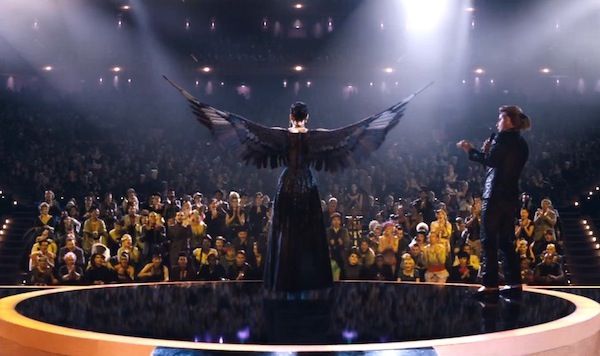
Katniss (Jennifer Lawrence) is placed at the centre of the image, allowing her to visually dominate the frame. As she is placed above the audience it suggests her power over them and perhaps foreshadowing her overthrowing the Capitol in the later films. Additionally, as the camera captures Katniss from behind making her appear as less as an individual and more of a symbol. As the Capitol audience cheers without truly understanding the true meaning of the Mockingjay dress, much like how progressive regimes can fail to see rebellion forming beneath their noses. This moment helps set the stage for the upcoming revolution, as the districts watching on their scenes will recognise the Mockingjay as their sign of hope and defiance. Through effective use of cinematography, lighting, costume design, and framing the film is able to subtly convey Katniss’ transformation from survivor to revolutionary leader.

 Ruby Reviews Films
Leave a comment