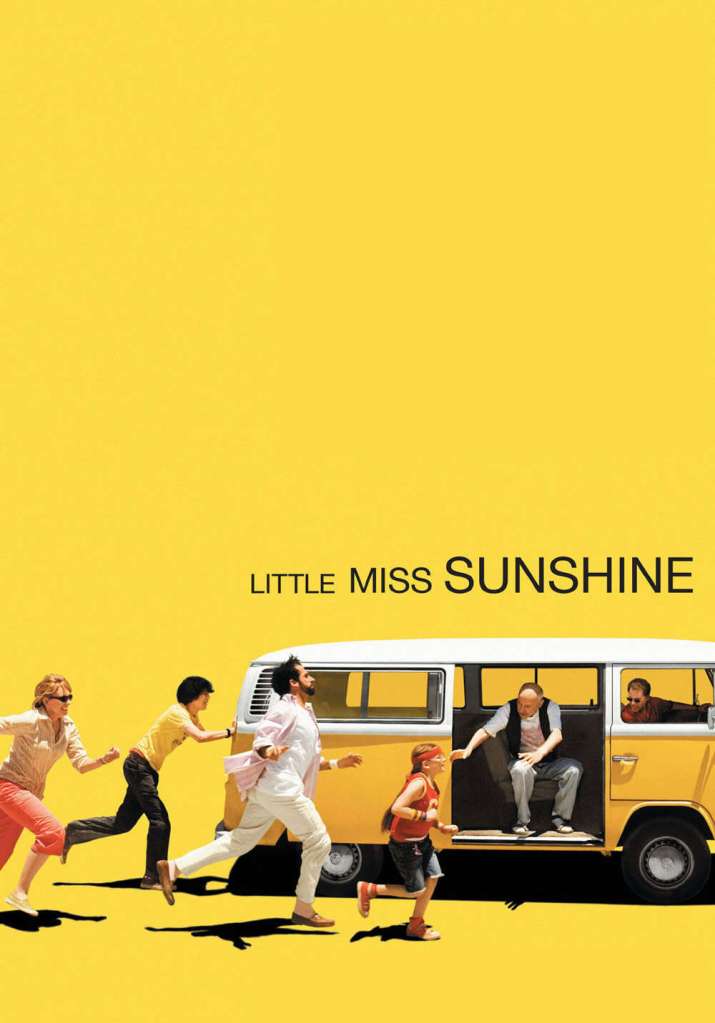
I watched this for the first time with my mum and dad, and I cried my eyes out, as they were the two who introduced me to this brilliant and moving film I owe them a massive thank you. The mixture of themes such as family and individuality, with the heartfelt and humorous moments, perfectly comes together to create this amazing film. This film is so wonderful as it perfectly celebrates the importance of being true to oneself and showing others the same love and acceptance you would like to receive, the characters always look past each other’s imperfections and flaws, they love each other because of who they are, not who they could be. That is the perfect way to describe your love for your family, acceptance is the most important thing you can give any family member. The unconventional blending of humour and drama marks Little Miss Sunshine as a beloved film of the mid-2000s and contributes to a much wider appreciation of indie cinema.
At its core, Little Miss Sunshine is a film about the importance of family supporting each other and coming together in times of need. Despite the many flaws, misunderstandings, and personal struggles the Hoover family face they ultimately come together to support Olive’s dream of competing in the beauty pageant. The film highlights how even a dysfunctional family can unite when faced with a shared goal or challenge. The road trip itself becomes a metaphor for the family’s journey of understanding and acceptance of one another, showcasing that love and support in a family can be more important than perfection. Dayton and Faris show the united family through the representation of Olive (played by Abigail Breslin) and Dwayne (Paul Dano) until we see the family on the bus the two characters are never seen properly interacting with each other, they are in scenes together but there is no conversation or interaction. This all changes when Dwayne finds out he is colourblind.
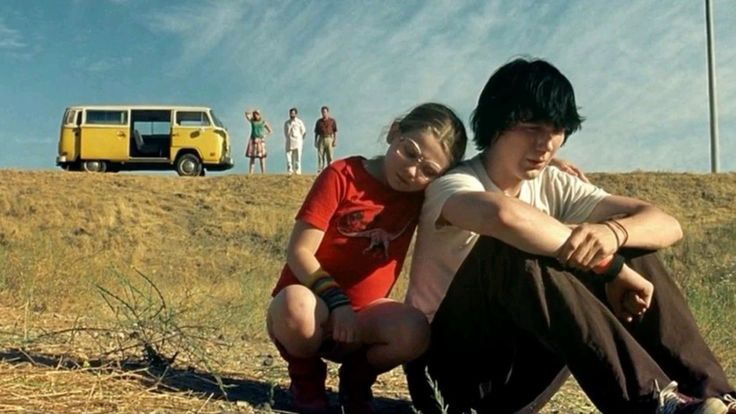
This scene suggests how far the siblings have come in their relationship. Their proximity in the picture above (Argyle’s body codes) implies they find comfort in each other. This scene is immensely emotionally moving, the effect is deepened through the ironic contrasting setting, the scene takes place in a beautiful, idyllic field which connotes a sense of joy and new life. As Dwayne’s dream of becoming a pilot has just been crushed this evokes a sense of juxtaposition.
The beauty pageant itself is a critical backdrop that critiques the societal standards of beauty, especially in the way young girls are subjected to ideals of physical perfection. As an unconventional contestant, Olive contrasts sharply with the other girls, who embody the traditional image of beauty. Her performance is marked by her awkwardness and earnestness, challenging the superficiality of the pageants and revealing how society’s expectations of women and girls can be harmful. This is shown through Olive’s judgement of her body when she arrives at the beauty pageant and sees the other girls, this emphasizes the harm surrounding the societal expectations of beauty pageants as the after-effect is so damaging.

The scene where Olive carefully examines her body from multiple angles is an example of the damage comparing yourself to the standards society sets. The beauty pageant is a catalyst moment in the film as it highlights how different Olive is from the other girls at the pageant. The effective use of costume in this scene further reinforces the absurdity of beauty standards, the use of the colour red (normally used to connote a sexy feeling) in this film detracts from the typical connotation and instead creates a bold and striking contrast to the other pageant contestants, here the colour red is used to symbolise Olive’s individuality and refusal to conform to traditional ideals of beauty (Bordwell). The film harshly critiques the absurdity of beauty standards, showing that real beauty often lies in authenticity and individuality, rather than conforming to societal ideals.
Little Miss Sunshine is a comedic yet touching exploration of the complexity of family dynamics, the pressures of societal expectations, and the importance of perseverance, individuality, and unconditional love. The Hoover family is a testament to how, even in the face of dysfunction and failure, love and support can help people find strength and meaning in their lives. The film opens with Olive Hoover being told that she has been selected as a finalist for the “Little Miss Sunshine” beauty pageant in California. Although Olive is not a typical contestant, she is determined to compete. Her parents are eager to support her, despite tension within their family.
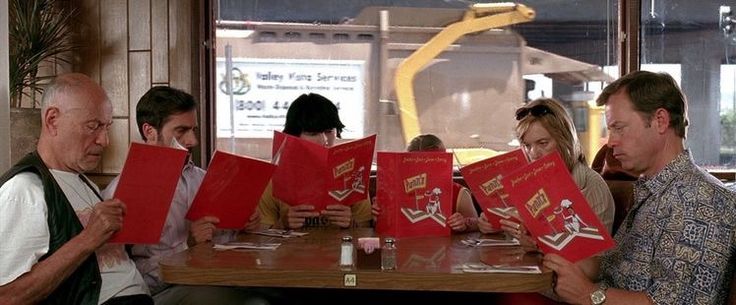
The lack of connection (emotional or physical) within the scene suggests the extent to which the family is dysfunctional, their lack of engagement with one another creates a sense of mistrust and instability. Furthermore, as all the characters hide behind the huge menus they can act as a buffer to the camera and as a result the audience has little idea how the family is actually feeling.
As Olive performs her routine, an impromptu dance to Rick James’ “Super Freak” is not at all what is expected, but it is an expression of Olive’s authentic self. When the performance ends the Hoover family’s reaction is immediately heart-warming and one of unwavering support.

At the end of the film, although Olive doesn’t win the pageant it is clear that the family’s shared experience and their unwavering support for each other becomes the true victory. As Olive’s family joins in with her routine it suggests the key message of the film is acceptance of individuality and the rejection of societal standards. The family’s unity at the end reflects the theme that, despite all their flaws and struggles, the love and support of family are the most important things.

 Ruby Reviews Films
Leave a comment