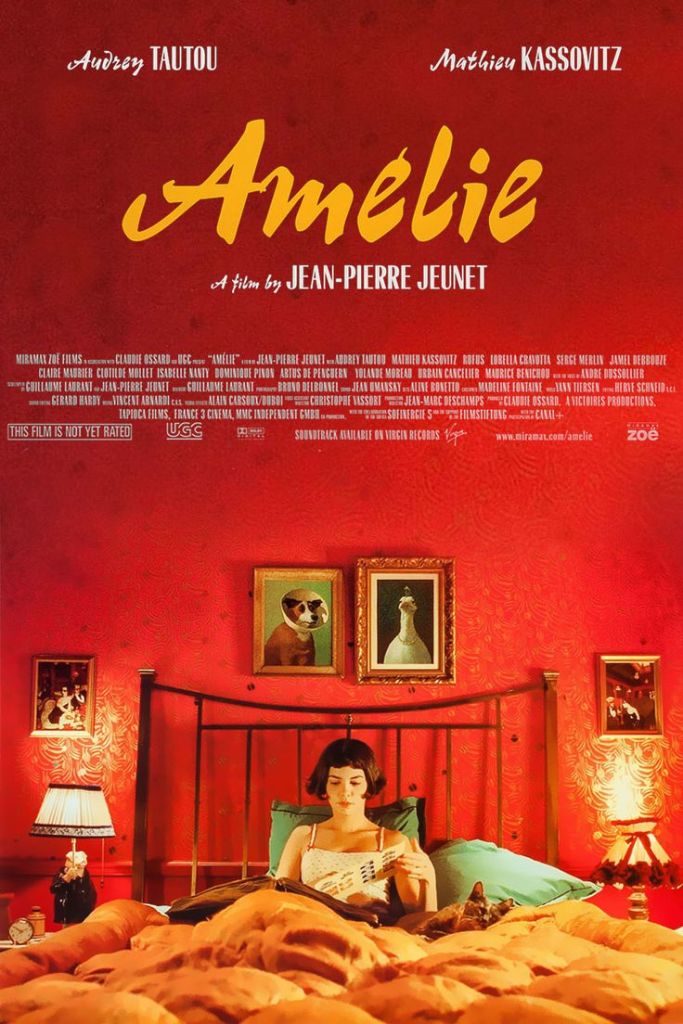
The film is a quirky French romantic comedy directed by Jean-Pierre Jeunet and starring Audrey Tatou in the lead role of Amélie Poulain, a shy and imaginative young woman living in Paris. The film is known for its whimsical style, vivid cinematography, and heart-warming story. Overall, Amélie was a critical and commercial success, becoming one of the highest-grossing French-language films of all time. The film’s influence extends beyond cinema, its portrayal of Paris as a whimsical, magical city, further cementing it as one of the most memorable French films of the 21st century.
Amélie’s style is immensely distinctive and rich in colour, the film is known for its bold saturated colour palette, with emphasis on red, green, and yellow tones. These colours give the film its signature dreamlike and whimsical quality, further contributing to the fairy-tale-like atmosphere. The film uses imaginative, playful visual techniques to represent Amélie’s inner world and thoughts. For example, her fantasies are sometimes illustrated through whimsical illustrations or subtle visual cues, such as when she imagines her world to be controlled by invisible forces, these elements blend the real and fantastical, creating a sense of magic in the everyday. The playful editing style adds to the charm of the film. The use of quick jump cuts and creative transitions emphasises the film’s lively, energetic pace. Often mirroring Amélie’s whimsical thoughts and actions, enhancing the overall sense of wonder and curiosity within the narrative.
A central theme of Amélie is the search for love and human connection. Although Amélie is shy and introverted she embarks on a journey of connecting with the people around her in her unique way, through small acts of kindness and anonymous interventions. While she is deeply in love with Nino, she struggles with opening herself up to him, showing the tension between desire and the fear of vulnerability. The film shows how love is not always straightforward but can be built through small, but meaningful gestures which Amélie accomplishes beautifully throughout the film.
The plot of Amélie revolves around Amélie Poulain, a shy, imaginative, and introverted young woman living in Paris. After her mother’s tragic death, Amélie was raised in a solitary environment by her overprotective father, and now she leads a quiet, reclusive life, working as a waitress in a small café. However, her life takes a surprising turn, when she finds a box of childhood mementoes hidden by her apartment’s previous tenants. When Amélie embarks on a mission to return the box the man Georgette, anonymously. The joyful reaction that follows this inspires Amélie to embark on a series of small, secret missions to bring happiness to the lives of people around her while remaining unseen. Helping a blind man experience the beauty of Paris through sound.
Amidst Amélie’s actions to improve the lives of others, she struggles with her own loneliness and emotional vulnerability. She secretly falls in love with Nino Quincampoix, a quirky young man who works at a photo collection booth. Nino’s journey to find out who has been collecting his discarded photo booth pictures leads him on his adventure which intersects with Amélie’s. Despite the growing feelings Amélie holds for Nino she is too shy and fearful of rejection to confess her love. Instead continuing her pattern of watching him from a distance and manipulating the events around him, hoping to make a connection without revealing herself. Eventually, Amélie realises that in her efforts to help others, she has neglected to confront her desires and take a risk in love. In the end, Amélie gathers the courage to approach Nino directly, and the two share a sweet, joyful moment of connection leaving the film on an optimistic note about love and personal growth.

 Ruby Reviews Films
Leave a comment