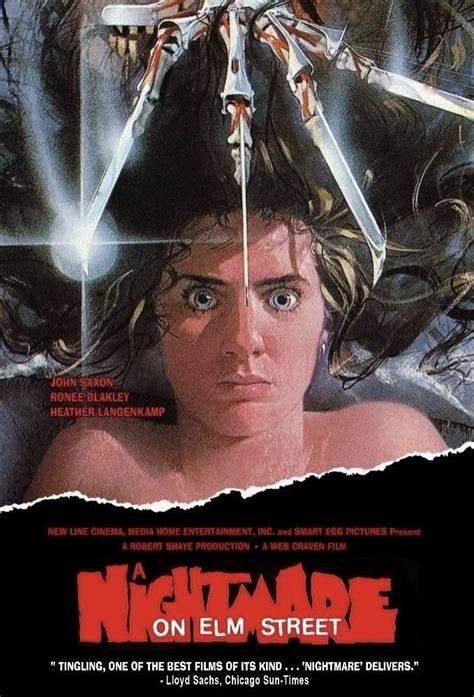
Nightmare on Elm Street (Craven, 1984) is a slasher horror film, part of the same movement as classics such as Halloween (Carpenter,1978) and Friday the 13th (Cunningham, 1980). The film is credited with the creation of the morality play that surrounds the sexual promiscuity in teenagers resulting in their eventual deaths. Despite the rich background of this film, I found myself unable to like it, despite refusing to turn the film off I couldn’t bring myself to uncover my eyes for more than a few seconds, this just wasn’t a film for me.
I found the exploration of the power your subconscious and the hold it can have over individuals incredibly interesting and is used in an incredibly effective manner within the film. This is increasingly effective when discussing the theme of parental guilt and secrets, as the film goes on we learn about the decisions made by the parents and can be reflected in the fates of the children, this decision highlights effects which unresolved guilt can have, including trauma and extreme fear. As the killings occur within dreams illustrating how the subconscious is a place of vulnerability where anything can manifest. As the character’s nightmares reflect their inner struggles and fears turning their dreams into a literal fight for survival. Contrastingly the film also presents the subconscious as a coping mechanism, Nancy for example is able to use her dreams to confront Freddy, highlighting that although the subconscious can be a place of fear it can also show power and resilience.
The theme of coming of age is incredibly significant within this film, it highlights the changes from childhood to adulthood and the difficulties that come with this change. Nancy’s transformation from a scared girl to a proactive fighter highlights the shift towards independence that comes with growing up. Her shift towards independence can also be attributed to a lack of trust in her mother, when Nancy confronts her mother reflects an incredibly important moment when blind trust is no longer placed in authority figures. This can be attributed to the political contexts of the era, as the lack of trust people held within the American presidency following Nixon’s Watergate scandal. Confrontation of fear is also significant within the context of coming of age within the film. The facing of your fears is represented as a key part of growing up, the teenagers must face Freddy, their own inner demons, and trauma associated with that, this symbolises the journey of facing the unknown and finding answers within yourself.
A factor I especially enjoyed within A Nightmare on Elm Street was Craven’s use of symbolic imagery, the recurring boiler room highlights this as it only appears within the dream world, representing a crossover between the teenagers subconsciousness and the place where Freddy carried out his awful schemes. Overall, the boiler room represents an overwhelming sense of fear and decay, this is particularly relevant as it can be assumed that Freddy died there and that was where he killed all his child victims. The corruption of the Elm Street House, which at the beginning of the film symbolises safety and familiarity, but as the film continues the house gradually mutates into a place corrupted by horror. The transformation of the safe space highlights the theme of betrayal, this is especially relevant when Nancy’s mother reveals Freddy’s hidden claw in the fireplace as it also suggests Nancy’s mother betrayed her by killing Freddy then stealing his claw.
For a film of its time Nightmare on Elm Street challenges the stereotypical gender roles within horror films as the protagonist, Nancy Thompson (played by Heather Langenkemp), evolves from a passive victim to proactive survivor she takes on the responsibility to challenge and defeat Freddy. Furthermore, the male characters also challenge hegemonic values of the time through the reliance on female strength and the displays of vulnerability, for example, when Rod Lane (played by Jsu Garcia) begs Nancy to help him when he is on the run from the police. Nightmare on Elm Street also touches on the theme of mental health and the negative effect of unresolved trauma, as the film progresses, and more people die Nancy’s deteriorating mental health highlights her extreme fear alongside her desperation to end what is happening to her.

 Ruby Reviews Films
Leave a comment